
Network Tokens: Why Your Stored Card Numbers Are Being Replaced
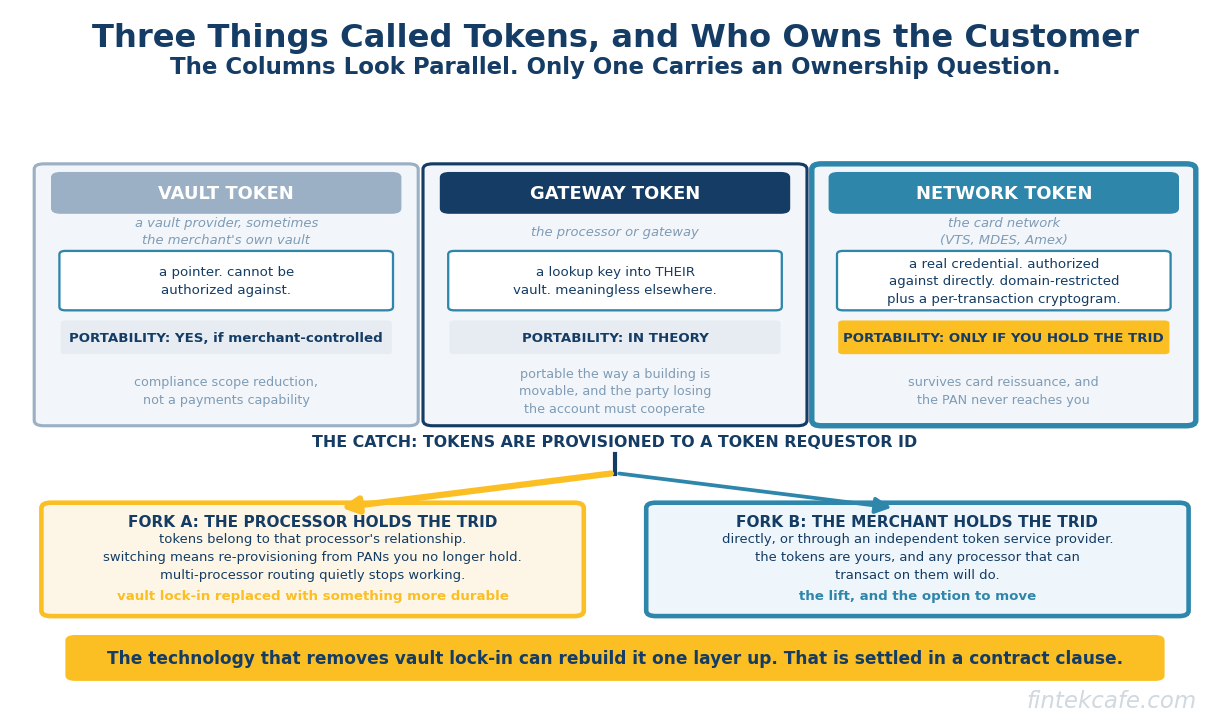
Three entirely different things are called tokens in payments, they are issued by three different parties, and conflating them is the reason businesses sign processor agreements that quietly relocate control of their customer credentials. A vault token protects stored data and reduces compliance scope. A gateway token is a processor's internal reference to a card it holds, portable in marketing material and awkward in practice. A network token is a distinct credential issued by Visa, Mastercard, or American Express, provisioned against a specific merchant, that replaces the stored card number outright and keeps working when the underlying card is reissued. The third type is the one changing authorization rates, fraud exposure, and subscription churn, and it is also the one carrying a strategic condition most executives never see: network tokens are provisioned through a token requestor, and whoever holds that role holds the relationship. This piece separates the three, explains the mechanics, quantifies the effects with the sources and their caveats, and gives the questions to ask a processor before signing.
Key Takeaways
- Three token types, three issuers, three purposes. Vault tokens are issued by a vault provider to reduce compliance scope. Gateway tokens are issued by a processor and reference a card that processor stores. Network tokens are issued by the card network itself and are a real credential that can be authorized against.
- Network tokens are domain-restricted and provisioned per merchant, so a stolen token is far less useful than a stolen card number. Each transaction carries a cryptogram that binds it to that merchant and that use, which is where the fraud reduction comes from.
- The credential updates itself. When a card is reissued after expiry, loss, or a breach, the network token keeps working, which directly reduces the involuntary churn that recurring billing businesses treat as a fixed cost of doing business.
- The published effects are real and vendor-sourced. Visa has reported approximately a 2.1 percent lift in authorization rates and a fraud reduction near 28 percent on tokenized traffic. Treat these as directional, because results vary substantially by portfolio, geography, and issuer mix.
- The strategic catch is the token requestor. Tokens are provisioned to a token requestor identifier, and if that identifier belongs to a processor rather than to the merchant, switching processors means re-provisioning the entire credential base. The technology that removes vault lock-in can rebuild it one layer up.
Three Things Called Tokens
| Type | Who issues it | What it protects | Portable to a new processor |
|---|---|---|---|
| Vault token | A vault or tokenization provider, sometimes the merchant's own vault | Stored card data, by removing the primary account number from merchant systems | Yes, if the vault is merchant-controlled and the provider supports export under a compliant transfer |
| Gateway or processor token | The payment processor or gateway | Nothing in itself; it is an internal reference to a card the processor holds | In principle through a PCI-compliant card data migration, in practice a negotiated, delay-prone project |
| Network token | The card network, through Visa Token Service, Mastercard Digital Enablement Service, or the American Express token service | The transaction itself, through domain restriction and a per-transaction cryptogram | Only to the extent the merchant controls the token requestor identifier it was provisioned under |
Vault tokens reduce scope, and that is all
A vault token is a surrogate value that points at a card number held in a compliant vault. Its purpose is compliance scope reduction: the merchant's application, database, and logs hold a meaningless string instead of a card number, so the systems that touch it fall outside the strictest PCI requirements. This is genuinely valuable and it is not a payments capability. The vault token cannot be authorized against. Something has to retrieve the real card number to send a transaction, and wherever that happens is where the risk still lives.
Gateway tokens are a relationship, not a technology
When a processor says it will store cards for a merchant and return a token, it is offering a lookup key into its own vault. The card is the processor's copy, the token is meaningful only to that processor, and the merchant now has a credential base it cannot use anywhere else.
Processors describe this as portable, and the claim is technically defensible. PCI DSS contemplates compliant card data migration between providers, and it happens regularly. The practical experience is different: the migration requires the outgoing processor's cooperation during the exact period when it is losing the account, it runs through a compliance-approved transfer process on both sides, and it takes months of calendar time before a single transaction moves. The arrangement is portable in the sense that a building is movable.
Network tokens are a different object entirely
A network token is issued by the card network and is a payment credential in its own right. It has its own number in card number format, it is restricted to a defined domain, usually a specific merchant and channel, and it is authorized against directly rather than being swapped back for a card number at the last moment. The underlying account is never exposed to the merchant at all.
The domain restriction is the security property that matters. A card number stolen from one merchant works at every merchant. A network token stolen from one merchant works at that merchant, in that channel, and only when accompanied by a valid cryptogram it cannot generate. This is the same mechanism already familiar from mobile wallets, where the device holds a token rather than a card number. Card-on-file network tokenization applies that model to stored credentials for ordinary web and app checkout.
How It Actually Works
Provisioning
The merchant, or a token requestor acting on its behalf, sends the card number to the network's token service along with the requestor identifier and the intended domain. The network validates with the issuer, generates a token bound to that requestor and domain, and returns it along with metadata: the last four digits of the underlying card, the card art, the issuer, and a payment account reference.
That payment account reference deserves attention. It is a non-sensitive identifier that maps back to the same underlying account across all tokens derived from it, which is what allows a merchant to recognize that a customer's phone wallet token and their saved web token are the same card without ever holding the card number. Loyalty matching, fraud analysis, and deduplication all depend on it.
The cryptogram
At transaction time the token is accompanied by a cryptographic value computed for that transaction, sometimes described as a token authentication verification value for card-on-file and e-commerce traffic. The issuer validates it as part of authorization. The token alone is insufficient, which is what makes a token database breach far less consequential than a card database breach: the attacker obtains credentials that are domain-restricted and require a cryptogram they have no way to produce.
Lifecycle updates, and what they do to churn
This is the effect with the clearest financial consequence and the one least discussed in security-framed explanations.
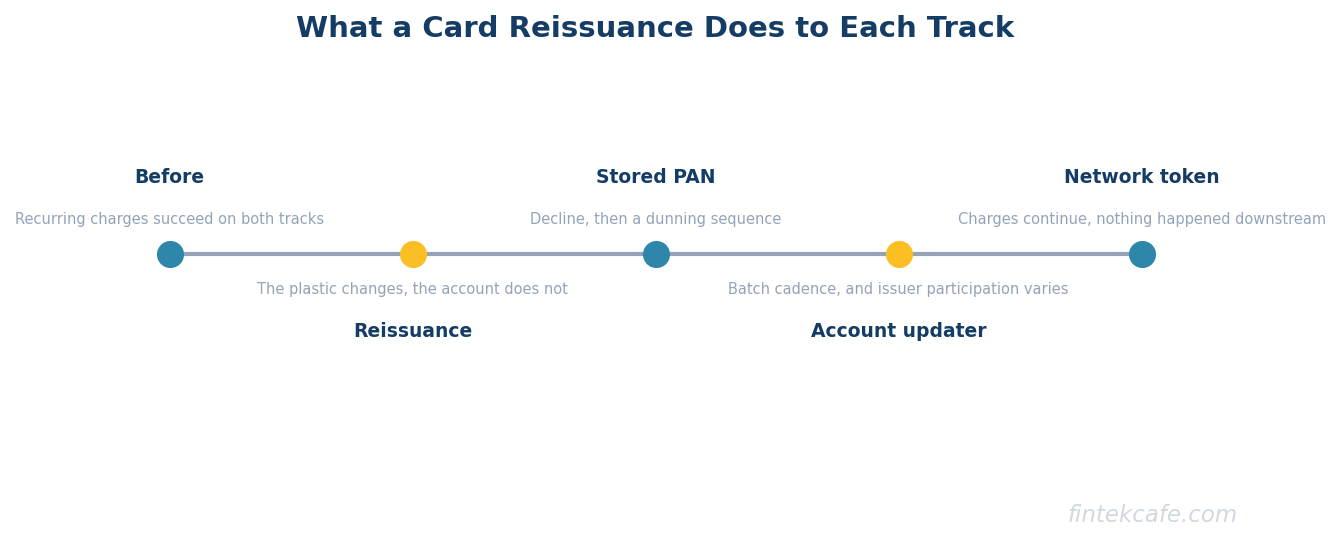
When a customer's card expires, is lost, or is reissued following a breach at some unrelated merchant, the stored card number at every subscription business that customer uses becomes invalid. The transaction declines, the dunning sequence starts, and some share of those customers never restore their payment method. That is involuntary churn, and for many subscription businesses it accounts for a meaningful fraction of total cancellations.
The pre-token answer was account updater services, the batch programs the networks operate to push updated card details to enrolled merchants. They work, imperfectly: coverage depends on issuer participation, updates arrive on a batch cadence, and the merchant must be enrolled and must process the file.
Network tokens change the mechanism. The token is bound to the account rather than to the plastic, so when the issuer reissues the card, the token continues to resolve to the live account. From the merchant's side nothing happened. The recurring charge that would have declined simply authorizes. For a business where a percentage point of monthly involuntary churn compounds across a subscriber base, this is the line item that justifies the migration on its own, separate from any security argument. The mechanics of why reissuance is so common in the first place sit on the issuing side, covered in how card issuing works.
The Measurable Effects, With Their Caveats
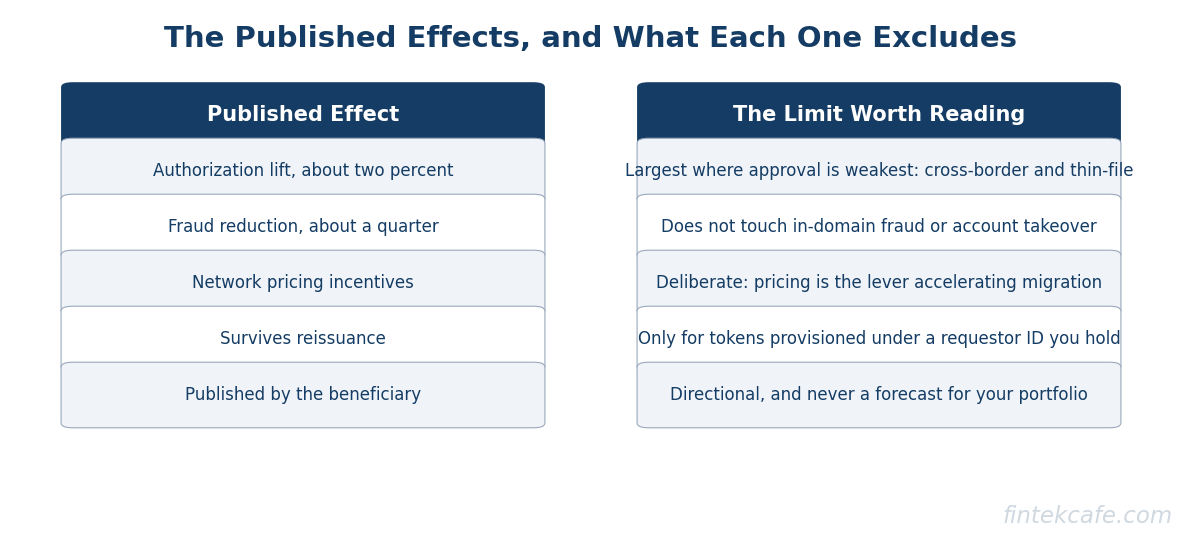
Three effects are consistently reported, and all three come from the networks that benefit from the migration, which is a reason to treat magnitudes as directional rather than as forecasts.
Authorization rate lift. Visa has publicly reported an approximate 2.1 percent uplift in approval rates on network-tokenized transactions, and Mastercard has published comparable figures. The mechanism is credible independent of the source: the issuer receives a credential it recognizes as domain-restricted and cryptographically bound to a specific merchant, which is materially better information than a bare card number, and the issuer's risk model approves more often on better information. The lift is largest where baseline approval rates are weakest, meaning cross-border traffic, thin-file customers, and recurring charges that resemble the pattern of a compromised card.
Fraud reduction. Visa has cited roughly a 28 percent reduction in fraud rates on tokenized transactions. The mechanism is structural rather than statistical: the credential is useless outside its domain, so the resale value of stolen data collapses and the most common downstream attack, using card data from one breach at a different merchant, is closed off. What tokenization does not touch is fraud committed within the domain, such as account takeover at the merchant itself, where the attacker is using the legitimate customer's session and the token behaves exactly as intended. The liability consequences of that distinction are worked through in payment fraud liability.
Network pricing incentives. The networks have attached commercial incentives to token traffic, and in several regions the pricing gap between tokenized and non-tokenized card-on-file transactions has widened. This is deliberate. Tokenization advances the networks' strategic position by making the credential a network-controlled object rather than a string the merchant possesses, and pricing is the lever available to accelerate it. The direction of travel is safe to assume even where specific rates are not public.
The Strategic Catch Executives Should Read Twice
Network tokens are provisioned to a token requestor, identified by a token requestor identifier, and the entity holding that identifier controls the token base.
This is the sentence that decides whether tokenization increases or decreases a business's freedom.
If the processor is the token requestor, and it usually is by default because that is the frictionless path, then the tokens belong to that processor's relationship with the network. Moving to a second processor does not move the tokens. The new processor is a different requestor, the tokens must be provisioned again, and re-provisioning requires the underlying card numbers, which the merchant does not have, because the entire point of the migration was to stop holding them. The exits that remain are asking the outgoing processor to cooperate in a migration it has no commercial reason to expedite, or running both processors in parallel and re-tokenizing customers as they transact, which takes as long as the customer base takes to cycle through.
The outcome is a business that replaced vault lock-in with something more durable. The old lock-in was at least a known problem with a known migration process. The new one is invisible until the day it matters and is frequently discovered during a processor negotiation, which is the worst possible moment to discover it.
There are three ways out, in descending order of effort and control.
Become the token requestor. The merchant registers directly with the networks, holds its own requestor identifier, and provisions tokens itself. The tokens are then the merchant's, usable with any processor that can transact on them. This is the strongest position and it carries genuine cost: network registration, certification with each network, and the ongoing operational responsibility of a credential lifecycle. It fits businesses at sufficient volume, and the same scrutiny a network applies to a direct relationship shows up in the risk review described in merchant underwriting.
Use an independent token service provider. A third party that is neither the processor nor tied to one holds the requestor role on the merchant's behalf. This keeps the tokens separable from processing without the full registration burden, and it substitutes one dependency for another that is at least aligned with the merchant on portability.
Negotiate the exit terms in the processing agreement. The weakest option and the one available to everyone. Contractual commitments on token migration support, defined timelines, and named technical cooperation obligations at least convert an ambiguity into an obligation before the relationship turns adversarial.
Multi-processor routing setups deserve a specific note here, because the entire premise of routing traffic across processors to optimize approval rates depends on both processors being able to transact on the same credential. When each processor holds its own tokens, the routing strategy quietly stops working.
Wallets, Devices, and Agent-Initiated Payments
The same rails carry more than card-on-file credentials, which is why this infrastructure question has a longer horizon than it appears.
Device tokens in phone wallets are the original consumer application of the same specification, with the token provisioned to the device and the cryptogram generated by the secure element. Card-on-file tokens for merchant-stored credentials came later and use the same underlying token service.
The next application is agent-initiated commerce. The card networks have begun defining credentials for transactions initiated by an AI agent acting on a consumer's behalf, through programs including Visa Intelligent Commerce and Mastercard Agent Pay, both of which extend the token framework rather than inventing a separate one. The design logic is the same one that made tokens work in the first place: bind a credential to a specific holder and a specific domain, require a cryptogram that only the legitimate holder can produce, and give the issuer enough context to make an approval decision about a transaction no human is present for. The broader shift this sits inside is covered in agentic commerce and the payments shift.
The executive implication is narrow and useful. A business that completes network tokenization and controls its own token requestor relationship is positioned for agent-initiated payment credentials as an incremental change. A business whose credentials sit inside a processor's requestor identifier will be asking that processor's permission again.
A Migration Playbook
| Stage | What to do | What to measure | The failure to avoid |
|---|---|---|---|
| Diligence | Establish who would be the token requestor, and get it in writing | Nothing yet; this is the decision that constrains everything after | Accepting the processor's default requestor role because it is the easiest path |
| Baseline | Record current authorization rate, decline reasons, involuntary churn, and fraud rate by segment before anything changes | Approval rate by card type, issuer, geography, and recurring versus one-off | Starting the migration without a baseline, which makes the result unprovable |
| Pilot | Tokenize a defined segment, ideally one geography or one card brand, keeping the rest unchanged | Approval rate difference against the untokenized control, in the same period | Tokenizing everything at once and attributing seasonal movement to the migration |
| Dual-token period | Run tokens and stored card numbers in parallel with fallback to the card number when a token transaction fails | Fallback rate, and which issuers drive it | Removing the fallback path before the fallback rate is near zero |
| Scale | Extend across the credential base, tokenizing new cards at capture and existing cards in the background | Coverage percentage, and approval rate lift on the covered portion | Leaving a long tail permanently untokenized and losing track of which is which |
| Steady state | Monitor token lifecycle events, keep the payment account reference mapping current, exercise portability assumptions | Involuntary churn trend, updated-credential events, token provisioning failures | Never testing whether the tokens could actually move, and finding out during a negotiation |
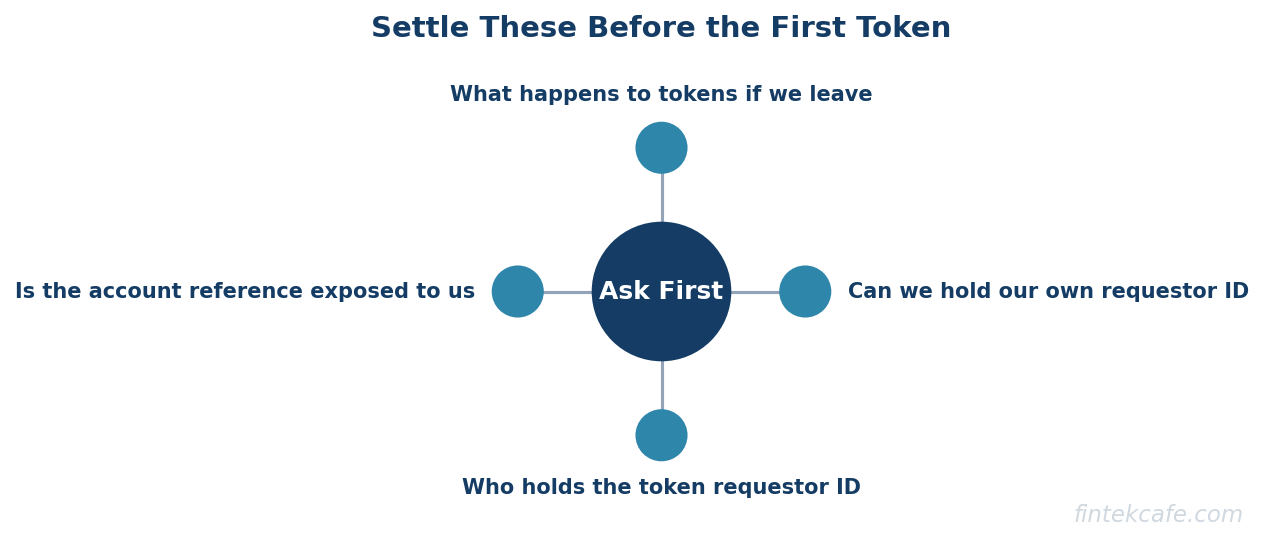
Five questions belong in any processor conversation, and the answers are more informative than the marketing material.
Who holds the token requestor identifier, and can the merchant hold its own. What specifically happens to the token base if the merchant leaves, described as a process with a timeline rather than as a reassurance. Is the payment account reference exposed to the merchant, since without it cross-channel customer matching does not work. Which networks and regions are supported today, since coverage is uneven outside the major markets. And is fallback to the stored card number supported automatically when a token transaction fails, which determines whether the migration can be run without risking a revenue dip.
Frequently Asked Questions
What is the difference between a network token and a gateway token?
A gateway token is a processor's internal reference to a card number that processor stores, and it is meaningless to any other party. A network token is issued by the card network itself, is a payment credential in its own right that can be authorized against, is restricted to a specific merchant and channel, and requires a per-transaction cryptogram. The practical differences are that network tokens improve authorization rates and survive card reissuance, while gateway tokens do neither.
Does network tokenization reduce PCI compliance scope?
It reduces it substantially, because the merchant stores a domain-restricted token rather than a primary account number, and the token is of limited use if stolen. It does not eliminate scope on its own. Wherever card numbers are captured, such as the checkout page or the point of initial provisioning, remains in scope, and the assessment still depends on the full data flow rather than on the storage format alone.
How do network tokens reduce subscription churn?
Because the token is bound to the underlying account rather than to the physical card, it continues to work after the card is reissued following expiry, loss, or an unrelated breach. The recurring charge that would have declined authorizes normally, so the customer never enters a dunning sequence and never has to re-enter a card. For subscription businesses, involuntary churn from reissued cards is a significant share of total cancellations, which makes this the effect with the most direct revenue impact.
What are VTS and MDES?
Visa Token Service and Mastercard Digital Enablement Service are the two largest card network token services, the systems that issue network tokens, bind them to a merchant or device domain, validate transaction cryptograms, and manage the credential lifecycle when an underlying card changes. American Express operates an equivalent service. All follow the EMVCo payment tokenisation specification, which is why one integration model works across networks.
Can network tokens be moved to a different payment processor?
Only if the merchant controls the token requestor identifier the tokens were provisioned under. If the processor holds that identifier, the tokens belong to that processor's network relationship, and switching means re-provisioning from card numbers the merchant no longer holds. The practical exits are the outgoing processor's cooperation, or a parallel period during which customers are re-tokenized as they transact. This is the single most consequential question to settle before signing.
The Bottom Line
Network tokenization is the rare infrastructure migration where the security case, the revenue case, and the regulatory direction all point the same way. The credential becomes useless outside its domain, approval rates improve because the issuer is given better information, and the involuntary churn that recurring revenue businesses have long treated as weather becomes something that can be reduced. There is no serious argument for staying on stored card numbers.
The argument worth having is about ownership. A migration executed on a processor's requestor identifier delivers every operational benefit and hands over the customer credential base in the process, and that transfer is invisible until the day the business wants to leave. The businesses treating this as an infrastructure project are getting the authorization lift. The ones treating it as a strategic question are getting the lift and keeping the option to move, and the difference between those two outcomes is settled in a contract clause, before the first token is provisioned.
Related Articles
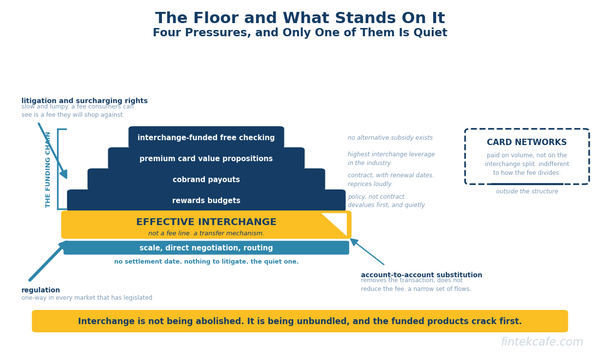
The Interchange Floor Is Cracking, and Card Economics Do Not Survive It Intact
Interchange is not being abolished, it is being unbundled. The losers are not the networks. They are issuers whose products are funded by a fee going soft.
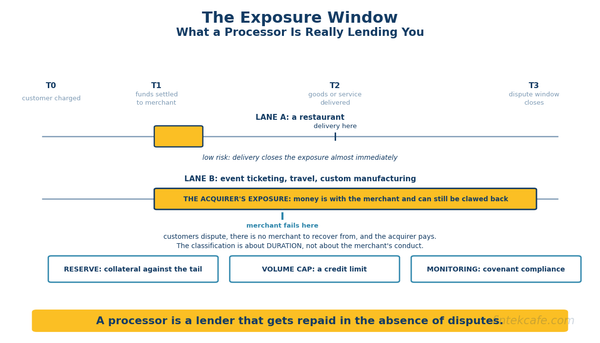
Merchant Underwriting: Why Payment Processors Reject Good Businesses
Processors underwrite credit risk, not just fraud. Why delivery timing drives rejections, how reserves work, and the founder playbook for approval.
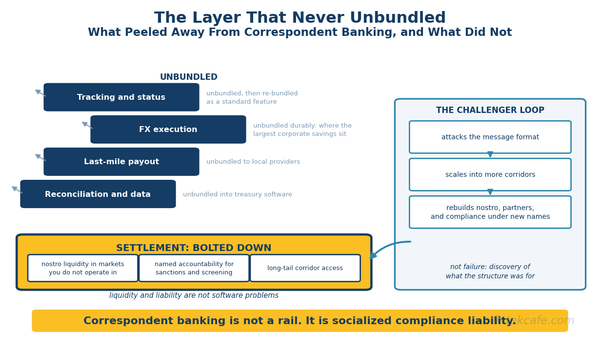
Cross-Border B2B Payments: Why the Correspondent Stack Refuses to Die
Correspondent banking survives every challenger because it is not a technology. It is a socialized compliance liability structure, and challengers rebuild it.